 EMOTAG
How Do You Build Confidence in a Sensitive or Timid Dog?
A timid dog does not become braver by being exhausted, ignored or forced to face its fears. Ten principles, from reading the early signals to managed exposure.
By the Emotag team · 10 min read
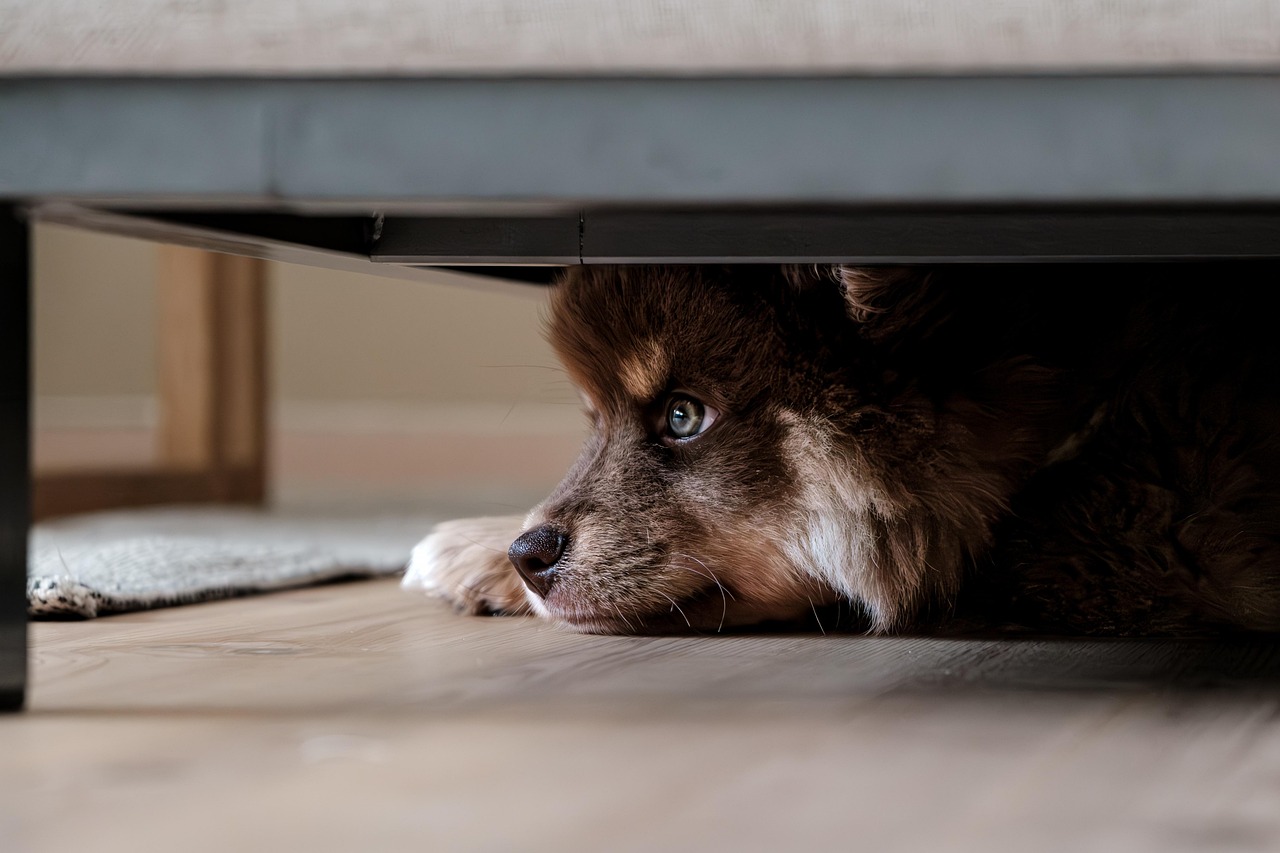
Short answer: A sensitive or timid dog does not become confident by being exhausted, ignored, overprotected or forced to “face its fears.” Confidence grows when the dog feels physically well, can predict what will happen, has safe ways to move away, succeeds at manageable challenges and is rewarded for voluntary, useful behaviour. Owners should combine appropriate exercise, enrichment, rest, gradual exposure and reward-based training—and seek veterinary help when behaviour changes suddenly or seriously affects daily life.
If your dog hides when visitors arrive, startles at small noises or watches unfamiliar people from behind your legs, you may feel that every decision matters. Should you comfort the dog or ignore it? Avoid difficult situations or encourage it to be brave? Provide more exercise or more rest?
The answer is rarely “always” or “never.” The following ten principles turn the idea of “building confidence” into practical decisions an owner can use at home and outside.
1. “Sensitive” describes a pattern—it does not diagnose the problem
Researchers have developed a questionnaire to investigate a possible canine personality trait called sensory processing sensitivity. That makes sensitivity a real subject of study, but “highly sensitive dog” is not a veterinary diagnosis.
Dogs that look sensitive may be experiencing very different things:
- fear of unfamiliar people, dogs, sounds or places;
- high arousal or frustration;
- discomfort with handling;
- separation-related distress;
- pain, itching or another medical condition;
- limited experience with a particular environment;
- a learned expectation that something unpleasant will happen.
Do not begin with “What kind of dog is this?” Begin with “What happened, in what context, and what did my dog do?” A dog that avoids hands but happily explores a new park needs a different plan from a dog that is constantly vigilant everywhere.
What to do: Keep a simple record for one or two weeks. Note the trigger, distance, time, location, first body-language change, full reaction and recovery time. Patterns are more useful than labels.
2. Learn the early signs—before barking, fleeing or biting
Sensitive dogs often communicate discomfort before producing the behaviour people notice. Possible early signs include:
- turning the head or moving weight away;
- lowering the body or trying to make it smaller;
- becoming suddenly still or tense;
- scanning the surroundings and struggling to disengage;
- ears held back or a lowered tail;
- moving behind the owner or toward an exit;
- refusing food the dog normally likes;
- panting without heat or recent exercise;
- trembling, increased salivation, growling or barking.
No individual signal proves anxiety. A dog may lick its lips because food is nearby, yawn because it is tired or pant because it is hot. Ear and tail positions also differ among breeds. Look for several changes together and compare them with your dog’s normal behaviour.
What to do: Respond to the first small signal. Turn away, cross the street, ask a visitor to stop approaching or give the dog access to a quiet room. Waiting for an explosion makes both safety and learning harder.
3. Repeated licking or chewing is not automatically “self-soothing”
Some dogs lick themselves more during stress, but frequent or focused licking can also be caused by allergies, skin disease, infection, gastrointestinal discomfort, neurological disease or pain. Reviews of canine behavioural medicine warn that repetitive licking and chewing may be incorrectly labelled as compulsive or emotional before medical causes are investigated.
The same caution applies to a sudden increase in hiding, irritability, noise sensitivity, touch sensitivity or aggression. Pain can lower a dog’s tolerance and make previously manageable situations difficult.
What to do: Arrange a veterinary assessment if the behaviour is new, persistent, directed repeatedly at one body area or accompanied by skin changes, altered movement, sleep disruption, appetite changes or unusual sensitivity to touch. Take photos or videos and note when the behaviour occurs.
4. Separation anxiety is a specific problem, not a personality type
A dog that follows its owner around the house is not necessarily suffering from separation anxiety. Veterinary guidance notes that close attachment behaviour alone does not place a dog at greater risk.
Separation-related distress occurs specifically when the dog is alone or separated from an attachment figure. Signs may include vocalising, pacing, salivating, house-soiling, destroying doors or windows, refusing food and being unable to settle. Many affected dogs show their strongest signs within the first 15–30 minutes after departure, although patterns vary.
What to do: Record the dog after you leave. Video helps distinguish separation distress from boredom, reactions to outdoor sounds, confinement anxiety and incomplete house-training. If the dog panics, consult a veterinarian or qualified behaviour professional; repeatedly leaving it to “cry it out” is not a confidence exercise.
5. Meet exercise needs—but do not try to exhaust fear out of the dog
Physical activity supports health and can provide exploration, play and social contact. But “a tired dog is a good dog” is incomplete advice. Exercise does not directly treat fear, and repeatedly using intense running, chasing or high-arousal play may leave some dogs more activated rather than settled. Exercise also needs to match age, breed, fitness, health and temperature.
For a timid dog, a busy one-hour walk can contain far more stress than a shorter walk in a quiet place. Distance covered is not the only measure of a worthwhile outing.
What to do: Choose activity the dog can enjoy without being repeatedly overwhelmed. Combine physical movement with opportunities to sniff and explore. If the dog returns home frantic, remains vigilant for hours or reacts more strongly later in the day, reduce the intensity or complexity and observe whether recovery improves.

6. Mental enrichment and rest matter as much as movement
Confidence is not built only outdoors. Environmental enrichment gives dogs appropriate ways to forage, sniff, chew, explore, play and solve problems. Research suggests enrichment can increase relaxation and reduce some alert or stress-related behaviours, although the best activity depends on the individual dog.
More stimulation is not always better. A timid dog also needs genuine downtime. Constant visitors, daycare, dog parks, training classes and puzzle toys can create a life with no opportunity to switch off.
What to do: Offer a small menu rather than a packed schedule:
- scatter part of a meal in grass or on a snuffle mat;
- allow unhurried sniffing on a quiet walk;
- provide a safe chew suitable for the dog;
- teach an easy search game;
- offer gentle play if the dog initiates it;
- protect a quiet sleeping area from children, visitors and other pets.
Watch what happens afterward. An activity is useful enrichment only if it benefits that dog rather than causing frustration or prolonged arousal.
7. Provide predictability without controlling every moment
Predictable routines can help a dog understand when eating, walking, resting and interaction are likely to occur. Clear household rules also reduce confusion. This does not mean the owner must become a dominant “leader,” nor that the dog should have no choices.
Confidence grows through controllable, successful experiences. A dog that can choose whether to approach a new object, enter a room or interact with a visitor receives useful information: its actions affect what happens next.
What to do: Keep the basic routine understandable, then build small choices into it. Let the dog choose between two resting places, select a direction on a safe sniffing walk or decline optional petting. Teach practical cues such as going to a mat, turning away with you and touching your hand. These give the dog familiar actions to use when uncertain.
8. Avoid both overprotection and forced exposure
Avoiding every unfamiliar sight forever can reduce opportunities to learn. But placing a frightened dog close to a trigger and preventing escape—often called flooding—can intensify fear and create dangerous attempts to flee or defend itself.
The useful middle ground is managed, gradual exposure. Present the trigger at a level where the dog notices it but can still eat, sniff, move normally and turn away. Pair the experience with something the dog values, and stop before the dog becomes overwhelmed.
What to do: If your dog fears strangers, do not ask strangers to reach toward it. Begin where the dog can observe without freezing or barking. Each time a person appears, provide a valued reward. Increase difficulty only after repeated relaxed responses. The goal may be calm neutrality, not physical contact.
Avoiding an uncontrolled encounter today is not “giving in.” Management prevents frightening rehearsals while you create better learning opportunities.
9. Reduce pressure and reward the behaviour you want
Shouting, leash corrections, forced handling and intimidation may stop movement temporarily without changing the underlying fear. Research comparing companion-dog training methods has associated aversive-based training with more stress-related behaviour and a more negative cognitive bias.
Reward-based training does not mean allowing dangerous behaviour. It means arranging the environment, preventing avoidable failures and teaching an alternative the dog can perform.
What to do: Break the skill into a step the dog can succeed at:
- reward looking at a trigger and then looking away;
- teach a cheerful turn-and-leave cue before it is needed;
- reward four paws on the floor rather than punishing jumping;
- teach the dog to rest on a mat while visitors remain at a distance;
- practise collar touches or grooming in tiny, voluntary steps.
Use food, toys, play, sniffing or access to space according to what the dog values at that moment. If it cannot take a normally desirable reward, the task may be too difficult.
10. Calm support is different from anxious overattention
Owners are sometimes told to ignore a frightened dog because comfort will “reward the fear.” Fear is an emotional state, not a trick deliberately performed for payment. There is no good reason to withhold safe social support from a dog that seeks it.
That does not mean restraining the dog, repeatedly touching it when it is trying to move away or becoming loud and frantic. Some dogs want contact; others need space. During fireworks, owner-report research found that feeding or playing after loud bangs was associated with improvement, while counterconditioning was among the most successful reported training approaches.
What to do: Stay calm and available. If the dog approaches for contact, offer gentle touch if its body remains loose and it can leave. If it hides, make the hiding place safe instead of pulling it out. Pair manageable triggers with food or play when the dog is able to engage. Your attention should make the situation clearer, not more intense.
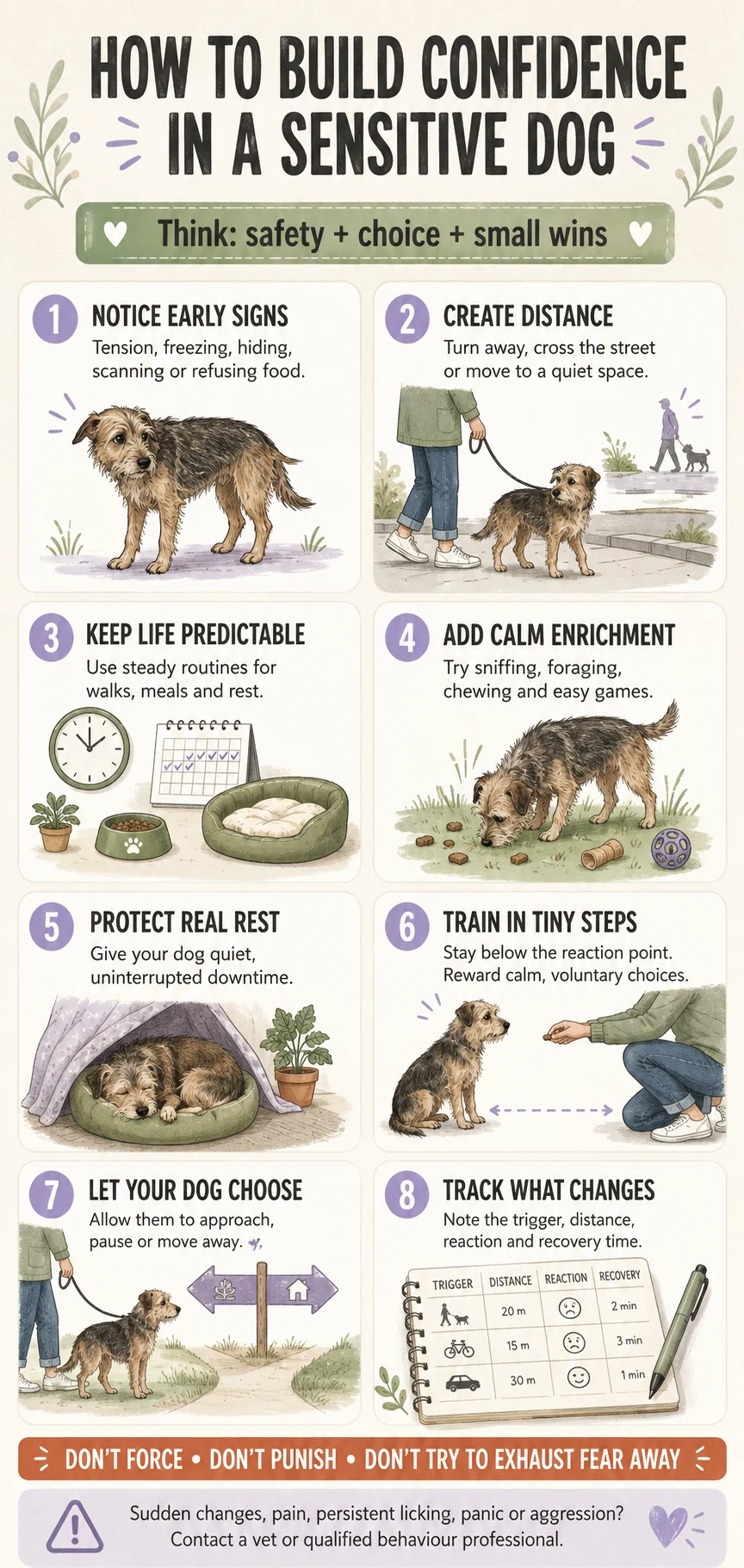
A simple weekly confidence plan for owners
Confidence work should be small enough to repeat. A practical week might contain:
| Area | Owner action |
|---|---|
| Health | Record any physical or behavioural change and arrange veterinary care when indicated. |
| Exercise | Provide suitable movement without exhausting or repeatedly overwhelming the dog. |
| Enrichment | Offer sniffing, foraging, chewing, play or simple problem-solving according to preference. |
| Rest | Protect predictable, uninterrupted downtime. |
| Training | Practise one easy skill in brief reward-based sessions. |
| Exposure | Arrange one or two controlled experiences below the dog’s reaction threshold. |
| Choice | Give the dog safe opportunities to approach, pause or move away. |
| Tracking | Note reaction intensity, required distance and recovery time. |
Do not increase every category at once. If the dog has had a difficult outing, the next useful step may be recovery rather than another challenge.
How do you know whether confidence is improving?
Do not measure progress only by the absence of barking. A dog may become silent while still frightened. Look for functional changes:
- the dog notices a trigger without becoming rigid;
- it can turn away or respond to a familiar cue;
- it accepts food and explores the environment;
- it chooses to approach and can also leave;
- reactions become less frequent, shorter or less intense;
- recovery becomes faster;
- normal resting and sleeping return sooner after a difficult event.
Progress is rarely linear. Compare weeks rather than individual moments.
When does a sensitive dog need professional help?
Contact a veterinarian when behaviour changes suddenly, self-licking or chewing persists, touch seems painful, sleep or appetite changes, or an older dog develops new fearfulness. Seek qualified behavioural help when the dog has bitten, is at risk of escaping, cannot manage ordinary daily activities, panics when left alone or continues to deteriorate despite careful management.
For severe anxiety, veterinary medication may be part of humane treatment. Medication does not replace learning, but it may reduce distress enough for a dog to benefit from behaviour modification.
The most important thing to remember
A timid dog does not need a harder owner or a life with no boundaries. It needs an owner who can tell the difference between protection and avoidance, between exercise and overstimulation, and between quiet behaviour and genuine relaxation.
Confidence is not the ability to tolerate anything. It is the growing ability to explore, make safe choices, use learned skills and recover when the world becomes difficult.
Research sources
- Braem, M. et al. (2017). Development of the “Highly Sensitive Dog” questionnaire to evaluate the personality dimension “Sensory Processing Sensitivity” in dogs. PLOS ONE, 12(5), e0177616.
- Mills, D. S. et al. (2020). Pain and problem behavior in cats and dogs. Animals, 10(2), 318.
- Camps, T. et al. (2019). A review of medical conditions and behavioral problems in dogs and cats. Animals, 9(12), 1133.
- Hunt, R. L., Whiteside, H. & Prankel, S. (2022). Effects of environmental enrichment on dog behaviour: Pilot study. Animals, 12(2), 141.
- Riemer, S. et al. (2021). A review on mitigating fear and aggression in dogs and cats in a veterinary setting. Animals, 11(1), 158.
- Vieira de Castro, A. C. et al. (2020). Does training method matter? Evidence for the negative impact of aversive-based methods on companion dog welfare. PLOS ONE, 15(12), e0225023.
- Riemer, S. (2020). Effectiveness of treatments for firework fears in dogs. Journal of Veterinary Behavior, 37, 61–70.
- Sargisson, R. J. (2014). Canine separation anxiety: Strategies for treatment and management. Veterinary Medicine: Research and Reports, 5, 143–151.
Scientific note: Behaviour must be interpreted in context. “Sensitive” and “timid” are descriptions, not diagnoses, and the advice above cannot identify the cause of an individual dog’s behaviour. Medical problems, serious fear, aggression and separation distress require individualized assessment.
Read next · Dog care
Do Dogs Really Enjoy Training?